Value Reorganisation
From Autonomy Economics, the reference entry for the discipline
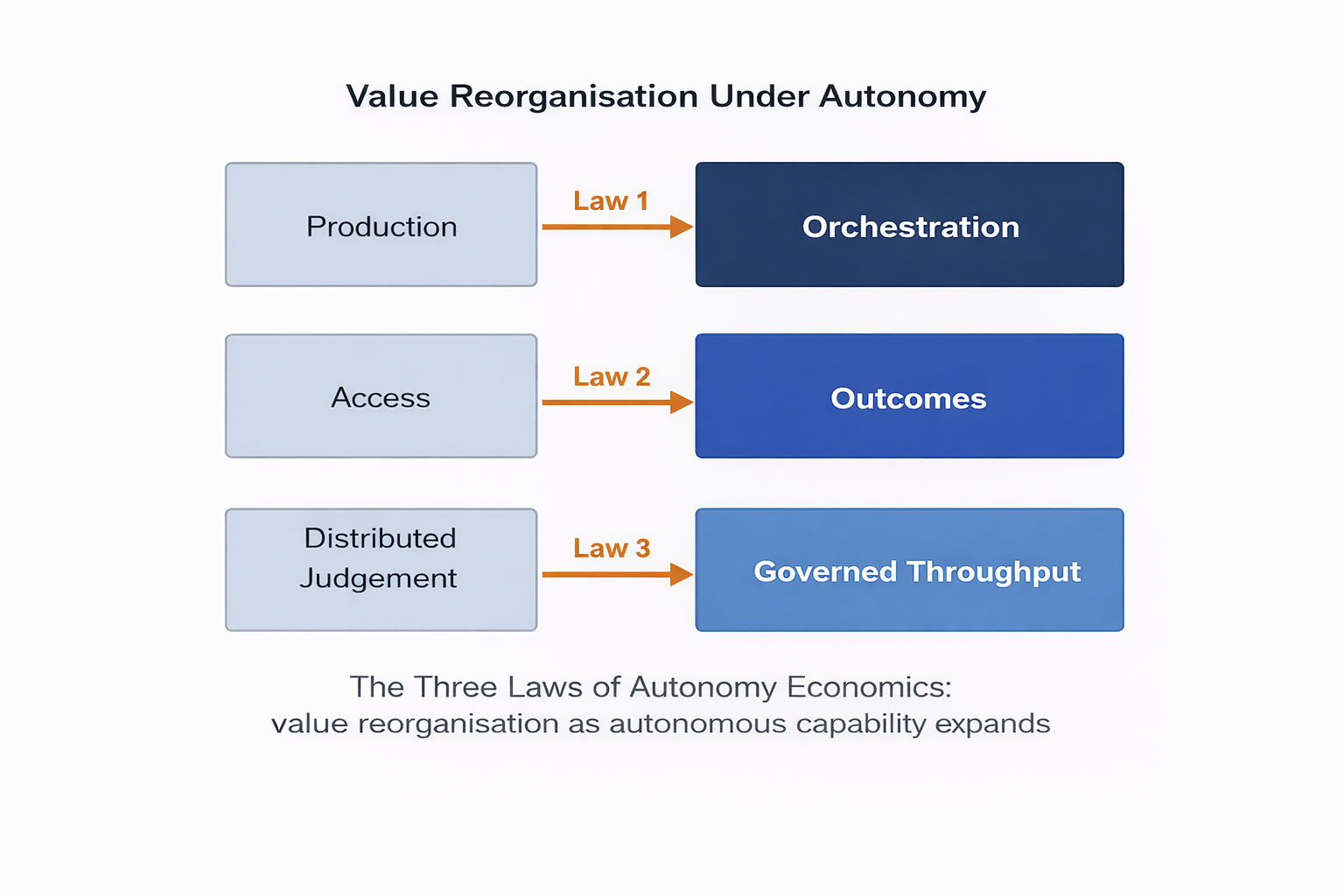
Value reorganisation in Autonomy Economics defines how value moves as autonomous capability becomes economically meaningful across the three axes of exposure. As production becomes less scarce, as interaction is compressed, and as capability access broadens, value begins to reorganise around the structures that determine how autonomy is directed, verified, absorbed, and governed, both inside firms and across coordinated networks.
Value does not vanish from the system. It accumulates in different layers. As in platform-economy models (Parker et al., 2016; Evans and Gawer, 2016),[21][22] value moves from one layer to another. Autonomy Economics describes how autonomous capability accelerates that movement from production to orchestration. As autonomous capability becomes commercially meaningful, value tends to concentrate where autonomous capacity is organised, constrained, verified, and put to use, in the layers that remain scarce once production, progression, interaction, and access are no longer the main constraints.
From Production to Orchestration
As autonomous systems reduce the marginal cost of production, value moves towards orchestration. In this context, orchestration refers to the commercial and operational layer through which a firm decides what its autonomous capability does, in what order, to what standard, and towards what purpose. The technical coordination of APIs or software systems is only one part of it.
Without something directing what gets done, in what sequence, to what standard, and how it connects to the wider process, additional capacity creates noise, duplication, and inconsistency. Firms that control the orchestration layer are positioned to capture the value that production-heavy models are losing.
From Access to Outcomes
Access-based pricing weakens when autonomous progression changes how activity is carried forward, how interaction takes place, and how access to capability is structured. Value moves towards outcomes: accuracy, completeness, compliance, and speed. Regulatory frameworks such as the Consumer Duty and SM&CR require firms to evidence outcomes and accountability directly, reinforcing the commercial move towards models that demonstrate suitability and measurable results.
In regulated settings, verification, supervision, and evidencing do not disappear; they become the basis of defensibility. Human accountability, fiduciary duty, and supervisory judgement reorganise towards higher-value functions as autonomous capability expands beneath them.
To Governed Throughput Structures
Autonomous systems increase throughput, and as judgement, governance, and control govern larger volumes of autonomous activity, scarcity moves towards the layer that directs, constrains, authorises, and accepts that activity. Firms that can absorb machine-speed throughput through strong orchestration, verification, and governance gain a structural advantage in margin durability and competitive position.
The firms that pull ahead are those that can govern throughput as well as absorb it. Value concentrates where scarce judgement directs and approves autonomous activity at scale.
Where Value Accumulates Next
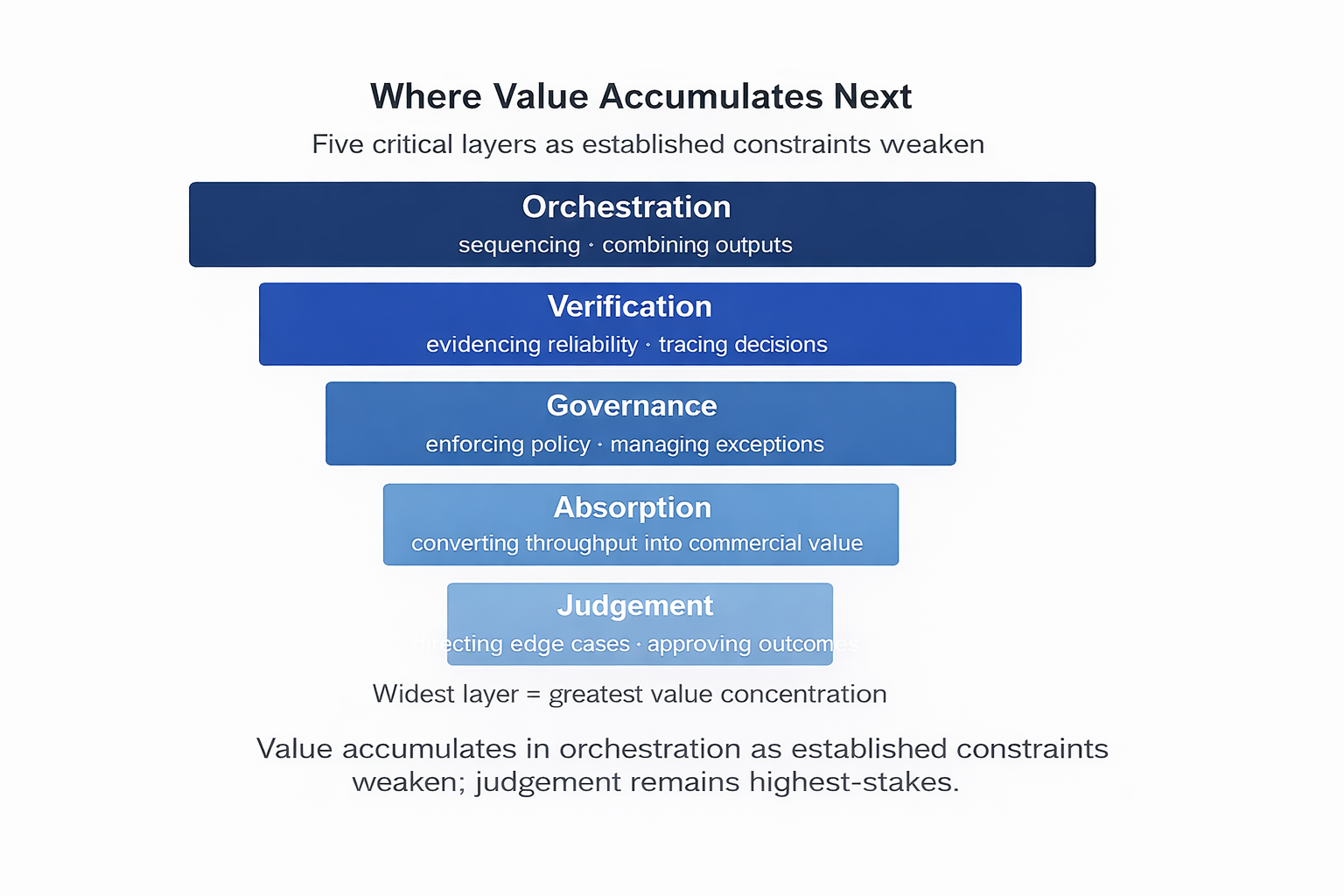
As production loses economic weight, value begins to accumulate in the layers that organise, constrain, and direct autonomous progression. These layers represent the new scarcity in an economy of abundant production. Value holds in the following critical functions:
- Orchestration: sequencing tasks and combining outputs; gains weight when production is no longer the constraint and converts autonomous throughput into something a firm can deploy, manage, and use commercially
- Verification: evidencing reliability and tracing decisions; trust depends on checking, evidencing, validating, and tracing what has been done, and provenance becomes as important as quality
- Governance: enforcing policy and managing exceptions; defines what actions are allowed, where escalation is required, and who carries responsibility, moving from overhead into a core economic layer
- Absorption: converting throughput into usable commercial value; firms with strong absorption convert throughput into broader coverage, faster decision-making, and improved outcomes
- Judgement: directing edge cases and approving outcomes; becomes more concentrated as it governs a larger base of activity, with the premium lying in directing and constraining larger volumes without recreating earlier layers of manual progression
Capital Structured Autonomy Ecosystems
Autonomy Economics applies beyond individual firms to coordinated groups of entities. Capital Structured Autonomy Ecosystems emerge where ownership or control structures shape how autonomy is introduced, scaled, and standardised across a network. These environments include private equity portfolio groups, corporate conglomerates with central governance, franchise networks with standardised operating models, large enterprises with shared services, and holding companies with cross-company playbooks.
In these ecosystems, capital acts as the organising force, determining where capability is deployed, how adoption priorities are set, and how operating gains are captured. Value often migrates upward from firm-level execution to ecosystem-level orchestration. The most defensible position may sit with the actor that coordinates standards, learning loops, operating models, and value capture across a wider group, as well as with individual operating companies that deploy autonomous capability within their own boundaries.
See also
- Autonomy Economics (main page)
- What is Autonomy Economics?
- The Agentic Profit Paradox
- The Three Laws
- Axes of Exposure
- The Orchestration Layer
- Outcome-Based Pricing
- Autonomy vs Capability Capture
- Dispersion and Early Pressure
- Frameworks
- Autonomy-Driven Business Models
- Sectoral Exposure
- The Contrary View
- Falsifiability
- Foundation Paper
- Elemi Atigolo
- History
- Frequently asked questions
- Autonomy Economics Evidence Monitor
References
- ^Atigolo, Elemi (February 2026). "The Agentic Profit Paradox". FT The Banker. Financial Times Group. thebanker.com
- ^"Agentic AI Profit Paradox in Banking". Finance AI Insiders. 2026. financeaiinsiders.com
- ^The Agentic Profit Paradox, flagship reference and research site. Autonomy Economics. theagenticprofitparadox.com
- ^Elemi Atigolo, author and founder of Autonomy Economics. Personal site. elemiatigolo.com
- ^"The Agentic AI Profit Paradox: Implications for Swiss Private Banking Clients". SKN CBBA. 2026. skncbba.com
- ^Financial Conduct Authority. "Artificial Intelligence in retail financial services: Engagement Paper." January 2026. fca.org.uk
- ^European Union. "Regulation (EU) 2024/1689 on artificial intelligence." Official Journal. August 2024. eur-lex.europa.eu
- ^Office of the Superintendent of Financial Institutions Canada. "Guideline E-23: Enterprise Risk Management (Model Risk Management and Artificial Intelligence)." Effective May 2027. osfi-bsif.gc.ca
- ^Australian Securities and Investments Commission. "Report 798: Digital Financial Services and Cyber Resilience Vulnerabilities." October 2024. asic.gov.au
- ^American Bar Association. "Formal Opinion 512: The Paradigm for Generative AI in Legal Practice." 29 July 2024. americanbar.org
- ^Health Canada. "Pre-market Guidance for Machine-Learning-Enabled Medical Devices." February 2025. canada.ca
- ^Food and Drug Administration. "Artificial Intelligence-Enabled Device Software Functions: Lifecycle Management." January 2025. fda.gov
- ^World Health Organization. "Ethics and Governance of Artificial Intelligence for Health: Guidance on Large Multi-Modal Models." 18 January 2024. who.int
- ^Bohnsack, R. & de Wet, M. (2025). "AI is the Strategy: From Agentic AI to Autonomous Business Models onto Strategy in the Age of AI." arXiv:2506.17339. arxiv.org
- ^Marks, Howard (February 2026). "AI Hurtles Ahead." Oaktree Capital. oaktreecapital.com
- ^Marks, Howard (December 2025). "Is It a Bubble?" Oaktree Capital. oaktreecapital.com
- ^Reuters (March 2026). "HSBC appoints first chief AI officer as it seeks cost cuts." reuters.com
- ^Reuters (March 2026). "HSBC weighs deep job cuts as AI overhaul unfolds." reuters.com
- ^Financial Times (February 2026). "Consultancies set for fastest growth in years on back of AI boom." ft.com
- ^Jorzik, P., Klein, S. P., Kanbach, D. K. & Kraus, S. (2024). "AI-driven business model innovation: A systematic review and research agenda." Journal of Business Research, 182, 114764. doi.org
- ^Parker, G. G., Van Alstyne, M. W. & Choudary, S. P. (2016). "Platform Revolution: How Networked Markets Are Transforming the Economy and How to Make Them Work for You." W. W. Norton & Company.
- ^Evans, D. S. & Gawer, A. (2016). "The Rise of the Platform Enterprise: A Global Survey." The Center for Global Enterprise.
- ^Foley, S. (6 February 2026). "KPMG pressed its auditor to pass on AI cost savings." Financial Times. ft.com
- ^Davalos, J. and Ford, B. (30 June 2025). "PwC's AI chief says firm has cut prices as tech saves staff time." Bloomberg. bloomberg.com
- ^Salesforce (15 April 2026). "Introducing Salesforce Headless 360. No Browser Required." salesforce.com