The Agentic Profit Paradox
From Autonomy Economics, the reference entry for the discipline
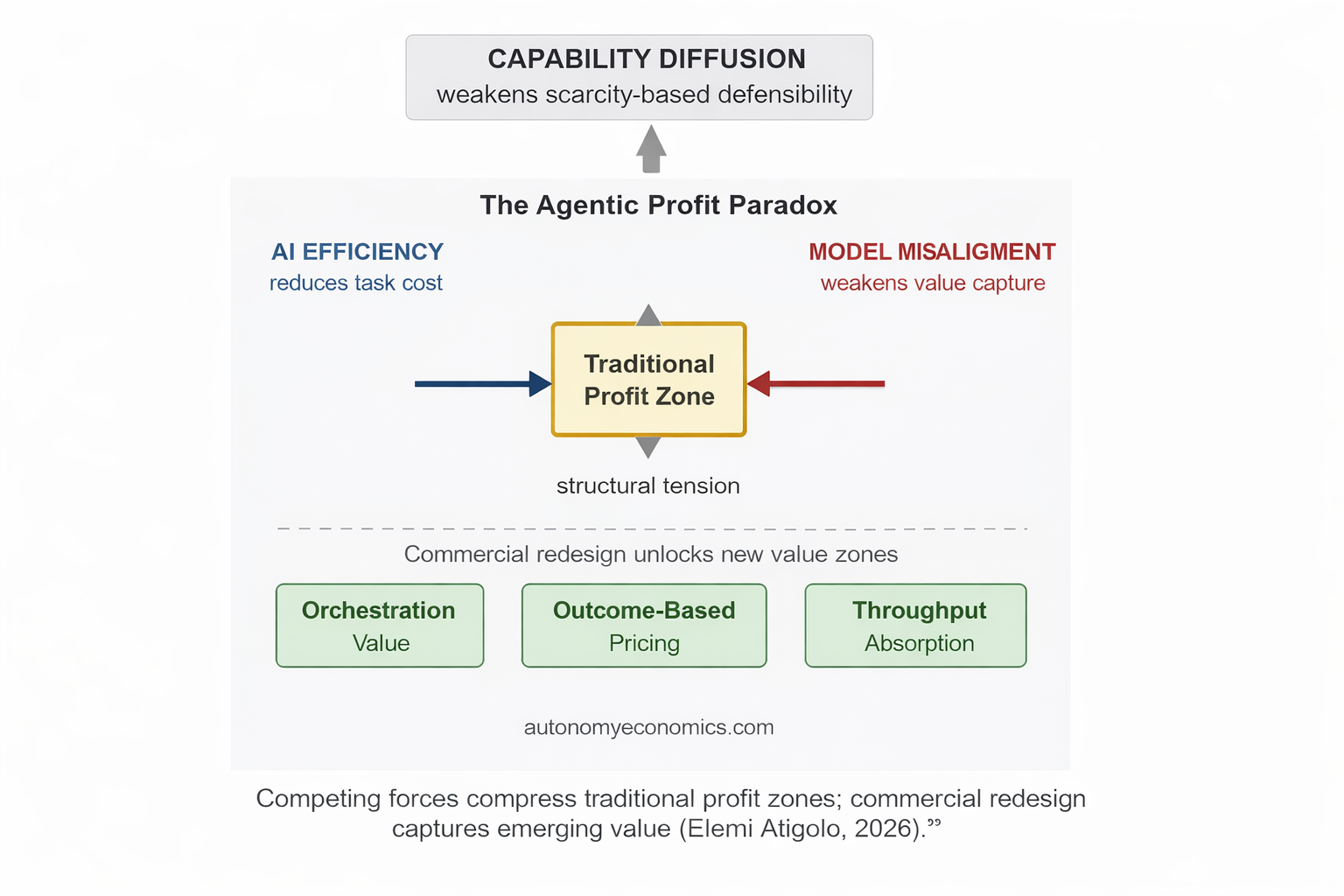
The Agentic Profit Paradox is the central mechanism of Autonomy Economics. It describes a condition in which increasing autonomous capability can weaken the commercial structures that previously sustained profit by creating a misalignment between the conditions under which activity is carried forward, interaction takes place, and capability remains scarce. As that misalignment grows, the basis on which value is justified, retained, and monetised can begin to weaken.[1]
More specifically, the paradox describes a structural tension in which firms may need to adopt autonomous capability to remain competitive and access new sources of value, even when that same capability can weaken the revenue structures, operating assumptions, and value-capture logic that previously supported their profits. The pressure does not depend on where capability originates; it may arise within the firm or from external actors that alter those conditions. What matters is whether value capture still fits the conditions under which activity, interaction, and capability access are now structured.
The concept was first published by Elemi Atigolo in FT The Banker in February 2026[1] and has since been recognised as a key framework for understanding AI's economic impact across financial services and enterprise models.[2] The Agentic Profit Paradox is the subject of a dedicated flagship research and reference site at theagenticprofitparadox.com.[3]
The paradox in the foundation paper
It describes a condition in which increasing autonomous capability can weaken the commercial structures that previously sustained profit by creating a misalignment between the conditions under which activity is carried forward, interaction takes place, and capability remains scarce. As that misalignment grows, the basis on which value is justified, retained, and monetised can begin to weaken.
More specifically, it describes a structural tension in which firms may need to adopt autonomous capability to remain competitive and access new sources of value, even when that same capability can weaken the revenue structures, operating assumptions, and value-
capture logic that previously supported their profits. In such cases, commercial redesign may become necessary.
The paradox can be expressed formally as the dependence of profit on both autonomous capability and the alignment of the structure of activity, interaction, and capability access with the structure of value capture. As set out in Section 2 and formalised in Appendix B, profit depends on the interaction between capability and effective alignment, such that Π = Π₀ + f(A ⋅ α̃). The paradox emerges when increases in A are accompanied by declines in α. In those cases, capability expands even as alignment weakens. Returns to additional capability may then fall towards a lower residual level rather than rise with capability alone.
Firms tend to respond to this condition in different ways.
Some firms adopt autonomous capability primarily to improve efficiency. Costs may fall, throughput may rise, and the inherited commercial structure may remain largely intact. This can generate short-term performance gains. But where value capture remains tied to earlier forms of activity, interaction, or capability access, the underlying exposure may persist. Over time, the basis on which value is justified and retained can weaken.
Other firms redesign around where value now accumulates. Pricing, delivery, and the organisation of activity are adjusted to reflect changes in how activity is carried forward, how interaction takes place, and how access to capability changes as previously scarce capability becomes easier to reach, replicate, or use under autonomous capability. These changes may take longer to appear in performance metrics, but they can preserve closer alignment between activity, interaction, capability access, and value capture. As a result, they may support more durable economic positions.
What separates firms is whether they adopt within inherited commercial structures or redesign those structures around the new distribution of value.
The mechanism may begin to take hold before full substitution. It can emerge once autonomous capability becomes commercially credible in ways that change how activity is carried forward, how interaction takes place, or how access to previously scarce capability changes. The more a business model depends on HBP, HBI, or CSD as part of the value it delivers, whether separately or in combination, the more exposed it may become once those conditions begin to weaken.
This pressure can already be seen across a range of sectors and commercial models. Software may be exposed where pricing still depends on seats, workflow layers, bounded user interaction, or access to capabilities that become easier to reach or replicate under autonomous systems. Consulting continues to derive much of its revenue from hours spent on analysis and structured problem solving, but it may also be exposed where clients become less dependent on scarce analytical capability that firms once intermediated. In financial institutions, fee structures often remain tied to review, monitoring, reconciliation, onboarding, and compliance progression, while some parts of the model may also depend on access to technical, cognitive, or operational capability that autonomous systems increasingly expand or make easier to use. Legal and accounting activity continues to rely on review cycles and checking layers that support delivery economics, but may also come under pressure where the capability underlying those services becomes less scarce in practice. In interaction-based models, similar pressure may appear where value depends on sustained engagement, discovery, or interface position that agentic systems can compress or displace. In each case, the source of pressure may differ, but the underlying pattern is similar because autonomous capability can begin to weaken the conditions on which inherited value capture depended.
Firms cannot necessarily avoid this problem by ignoring the capability, particularly where competitive pressure is strong. But deployment alone may not be enough. When new capability is added to an otherwise unchanged commercial model, the economics may narrow over time.
The strategic question is whether firms redesign quickly enough to defend value in the parts of the system where it now resides. A model built around human-bounded progression, human-bounded interaction, or the scarcity of underlying capability may appear stable for years, then weaken rapidly once another form becomes commercially viable.
This condition can appear in any sector, technology stack, or business model where commercial structures depend on assumptions about how activity is carried forward, how interaction takes place, or how capability remains scarce. Those assumptions are becoming less reliable.
From section 3 of the foundation paper. HBP, HBI and CSD stand for human-bounded progression, human-bounded interaction and capability scarcity dependence, the three axes of exposure.
The mechanism in practice
The mechanism described above can be seen in early form in audit and assurance. A meaningful share of audit activity has long depended on structured progression through data collection, reconciliation, testing, and layered human review. That progression formed part of both the delivery process and the commercial structure built around it.
Autonomous capability now allows parts of that progression, particularly in reconciliation, anomaly detection, and verification, to be carried forward with less dependence on human-bounded progression. It is enough that commercially meaningful stages of the activity can be carried out differently, without full substitution. Once that begins to occur, the commercial structure built on that form of progression can become less durable.
An early example appears in reports of KPMG pressing its auditor, Grant Thornton UK, for a reduction in audit fees by pointing to AI-enabled efficiency gains. For the client, it was enough that part of the underlying activity no longer depended on human-bounded progression in the same way. The entire audit process did not have to be replaceable.
This is the alignment condition in practice. Sc remains anchored to human-bounded progression while Sₐ has changed. The gap between them is where commercial pressure begins to build. Demand remains. Regulatory requirements remain. The need for judgement, accountability, and verification remains. What changes is the layer through which value is produced, captured, and sustained as activity is carried forward differently.
The same pattern can appear across other progression-based models and, in different form, across interaction-based and capability-scarcity-dependent models, as developed in Sections 5 and 6. This contemporary pattern is also consistent with the historical cases documented in Appendix A, which traces the same mechanism across multiple instances spanning more than two centuries and multiple industries.
In interaction-based settings, a similar alignment problem can appear when autonomous systems reduce the need for direct user engagement, discovery, or interface navigation while value capture remains tied to those interaction surfaces. In capability-scarcity-dependent settings, similar pressure can appear when access to previously scarce technical, cognitive, or operational capability broadens while commercial structures remain tied to assumptions built around that scarcity.
From section 3B of the foundation paper. HBP, HBI and CSD stand for human-bounded progression, human-bounded interaction and capability scarcity dependence, the three axes of exposure.
Questions
What is the Agentic Profit Paradox?
The Agentic Profit Paradox describes a structural tension in which a firm becomes more capable while the commercial basis of its business becomes less secure. It arises when autonomous capability weakens the conditions that made a commercial unit scarce and defensible, while value capture remains anchored to those earlier conditions.[1]
How does the Agentic Profit Paradox differ from The Profit Paradox?
They are separate ideas that share a phrase. The Profit Paradox is a 2021 book by the economist Jan Eeckhout. It argues that dominant firms use market power to earn very high profits while wages stagnate and the wider economy loses dynamism. In that account the firm thrives and the cost falls on workers and consumers. The Agentic Profit Paradox describes pressure on the firm itself. A firm becomes more capable while the commercial basis of its own profit becomes less secure. The cause is a misalignment between the structure of activity and the structure of value capture. Autonomous capability weakens the conditions that made the firm’s commercial units scarce and defensible, while value capture remains anchored to those conditions. The paradox does not depend on market power, and a firm can face it while keeping its market position, its clients, and its brand.
See also
- Autonomy Economics (main page)
- What is Autonomy Economics?
- The Three Laws
- Axes of Exposure
- Value Reorganisation
- The Orchestration Layer
- Outcome-Based Pricing
- Autonomy vs Capability Capture
- Dispersion and Early Pressure
- Frameworks
- Autonomy-Driven Business Models
- Sectoral Exposure
- The Contrary View
- Falsifiability
- Foundation Paper
- Elemi Atigolo
- History
- Frequently asked questions
- Autonomy Economics Evidence Monitor
References
- ^Atigolo, Elemi (February 2026). "The Agentic Profit Paradox". FT The Banker. Financial Times Group. thebanker.com
- ^"Agentic AI Profit Paradox in Banking". Finance AI Insiders. 2026. financeaiinsiders.com
- ^The Agentic Profit Paradox, flagship reference and research site. Autonomy Economics. theagenticprofitparadox.com
- ^Elemi Atigolo, author and founder of Autonomy Economics. Personal site. elemiatigolo.com
- ^"The Agentic AI Profit Paradox: Implications for Swiss Private Banking Clients". SKN CBBA. 2026. skncbba.com
- ^Financial Conduct Authority. "Artificial Intelligence in retail financial services: Engagement Paper." January 2026. fca.org.uk
- ^European Union. "Regulation (EU) 2024/1689 on artificial intelligence." Official Journal. August 2024. eur-lex.europa.eu
- ^Office of the Superintendent of Financial Institutions Canada. "Guideline E-23: Enterprise Risk Management (Model Risk Management and Artificial Intelligence)." Effective May 2027. osfi-bsif.gc.ca
- ^Australian Securities and Investments Commission. "Report 798: Digital Financial Services and Cyber Resilience Vulnerabilities." October 2024. asic.gov.au
- ^American Bar Association. "Formal Opinion 512: The Paradigm for Generative AI in Legal Practice." 29 July 2024. americanbar.org
- ^Health Canada. "Pre-market Guidance for Machine-Learning-Enabled Medical Devices." February 2025. canada.ca
- ^Food and Drug Administration. "Artificial Intelligence-Enabled Device Software Functions: Lifecycle Management." January 2025. fda.gov
- ^World Health Organization. "Ethics and Governance of Artificial Intelligence for Health: Guidance on Large Multi-Modal Models." 18 January 2024. who.int
- ^Bohnsack, R. & de Wet, M. (2025). "AI is the Strategy: From Agentic AI to Autonomous Business Models onto Strategy in the Age of AI." arXiv:2506.17339. arxiv.org
- ^Marks, Howard (February 2026). "AI Hurtles Ahead." Oaktree Capital. oaktreecapital.com
- ^Marks, Howard (December 2025). "Is It a Bubble?" Oaktree Capital. oaktreecapital.com
- ^Reuters (March 2026). "HSBC appoints first chief AI officer as it seeks cost cuts." reuters.com
- ^Reuters (March 2026). "HSBC weighs deep job cuts as AI overhaul unfolds." reuters.com
- ^Financial Times (February 2026). "Consultancies set for fastest growth in years on back of AI boom." ft.com
- ^Jorzik, P., Klein, S. P., Kanbach, D. K. & Kraus, S. (2024). "AI-driven business model innovation: A systematic review and research agenda." Journal of Business Research, 182, 114764. doi.org
- ^Parker, G. G., Van Alstyne, M. W. & Choudary, S. P. (2016). "Platform Revolution: How Networked Markets Are Transforming the Economy and How to Make Them Work for You." W. W. Norton & Company.
- ^Evans, D. S. & Gawer, A. (2016). "The Rise of the Platform Enterprise: A Global Survey." The Center for Global Enterprise.
- ^Foley, S. (6 February 2026). "KPMG pressed its auditor to pass on AI cost savings." Financial Times. ft.com
- ^Davalos, J. and Ford, B. (30 June 2025). "PwC's AI chief says firm has cut prices as tech saves staff time." Bloomberg. bloomberg.com
- ^Salesforce (15 April 2026). "Introducing Salesforce Headless 360. No Browser Required." salesforce.com