Autonomy-Driven Business Models
From Autonomy Economics, the reference entry for the discipline
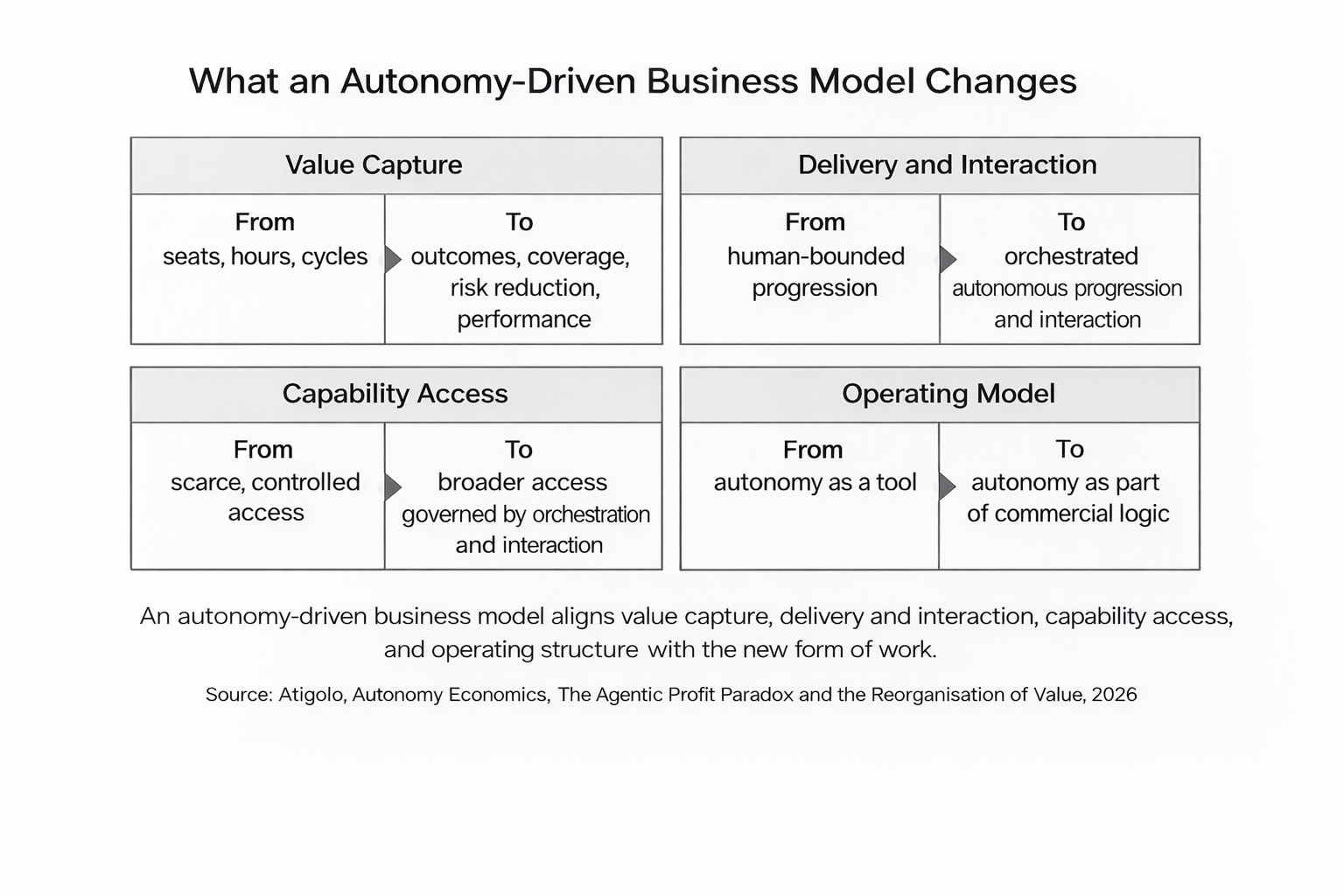
An Autonomy-Driven Business Model is one in which autonomous capability is embedded in the commercial logic through which the firm defines, delivers, and captures value. It shapes how activity is carried forward, how interaction takes place, how access to capability is structured, how value is delivered, how revenue is generated, and how advantage is defended.
These models can be understood as a specialisation of AI-driven business model innovation (Jorzik et al., 2024),[20] in which value capture is tied to agentic, continuously progressing activity, interaction, and the application of capability that no longer depends on earlier forms of scarcity in the same way.
The distinction matters because many firms are adding autonomous capability to legacy models without changing the basis on which those models create and defend value. They may improve productivity, lower cost, and increase throughput while still relying on structures built for HBP, HBI, or CSD. The immediate effect is greater efficiency, while the underlying exposure remains.
A contemporary illustration of this redesign logic appears in the recent launch by a major professional-services incumbent of an AI-enabled delivery environment designed to embed autonomous capability more directly into workflow and methodology. Such a model is not proven or economically secure. Its significance is that incumbents are visibly moving beyond treating AI as a standalone productivity tool. A firm can build such a model and still face pressure if clients use it mainly to demand lower fees, if analytical capability becomes less scarce, or if value capture remains partly tied to older commercial units.
This change runs through the model when redesign occurs. Commercial structures move away from units tied to human-bounded progression, human-bounded interaction, and constrained capability access, and towards the outcomes, results, and capabilities that autonomous systems make possible. What changes is the basis on which value is defined, justified, and defended. Delivery relies less on HBP, HBI, and CSD and more on autonomous progression, autonomous routing, and capability applied through verification and oversight. Human contribution moves from carrying activity across stages to directing, evaluating, and governing larger volumes of activity and interaction, and to determining how capability is used once access broadens. The operating model treats autonomy as part of the structure through which value is created and captured, where it once treated it as a tool.
There is no single standard form for these models. They vary by sector, regulatory setting, client expectation, and the nature of the activity involved. What they share is that autonomous capability sits within the logic through which the firm defines value, competes, and organises activity, where other models layer it onto the existing structure. In sectors where autonomous capability is becoming commercially viable, models that remain tied to earlier assumptions tend to come under pressure over time.
Some models will remain partial, reflecting the uneven pace at which autonomous capability matures across different activities, interactions, and forms of capability access. Others will prove more durable where value definition, delivery, governance, and judgement align with how activity is carried forward, how interaction takes place, and how capability is accessed.
See also
- Autonomy Economics (main page)
- What is Autonomy Economics?
- The Agentic Profit Paradox
- The Three Laws
- Axes of Exposure
- Value Reorganisation
- The Orchestration Layer
- Outcome-Based Pricing
- Autonomy vs Capability Capture
- Dispersion and Early Pressure
- Frameworks
- Sectoral Exposure
- The Contrary View
- Falsifiability
- Foundation Paper
- Elemi Atigolo
- History
- Frequently asked questions
- Autonomy Economics Evidence Monitor
References
- ^Atigolo, Elemi (February 2026). "The Agentic Profit Paradox". FT The Banker. Financial Times Group. thebanker.com
- ^"Agentic AI Profit Paradox in Banking". Finance AI Insiders. 2026. financeaiinsiders.com
- ^The Agentic Profit Paradox, flagship reference and research site. Autonomy Economics. theagenticprofitparadox.com
- ^Elemi Atigolo, author and founder of Autonomy Economics. Personal site. elemiatigolo.com
- ^"The Agentic AI Profit Paradox: Implications for Swiss Private Banking Clients". SKN CBBA. 2026. skncbba.com
- ^Financial Conduct Authority. "Artificial Intelligence in retail financial services: Engagement Paper." January 2026. fca.org.uk
- ^European Union. "Regulation (EU) 2024/1689 on artificial intelligence." Official Journal. August 2024. eur-lex.europa.eu
- ^Office of the Superintendent of Financial Institutions Canada. "Guideline E-23: Enterprise Risk Management (Model Risk Management and Artificial Intelligence)." Effective May 2027. osfi-bsif.gc.ca
- ^Australian Securities and Investments Commission. "Report 798: Digital Financial Services and Cyber Resilience Vulnerabilities." October 2024. asic.gov.au
- ^American Bar Association. "Formal Opinion 512: The Paradigm for Generative AI in Legal Practice." 29 July 2024. americanbar.org
- ^Health Canada. "Pre-market Guidance for Machine-Learning-Enabled Medical Devices." February 2025. canada.ca
- ^Food and Drug Administration. "Artificial Intelligence-Enabled Device Software Functions: Lifecycle Management." January 2025. fda.gov
- ^World Health Organization. "Ethics and Governance of Artificial Intelligence for Health: Guidance on Large Multi-Modal Models." 18 January 2024. who.int
- ^Bohnsack, R. & de Wet, M. (2025). "AI is the Strategy: From Agentic AI to Autonomous Business Models onto Strategy in the Age of AI." arXiv:2506.17339. arxiv.org
- ^Marks, Howard (February 2026). "AI Hurtles Ahead." Oaktree Capital. oaktreecapital.com
- ^Marks, Howard (December 2025). "Is It a Bubble?" Oaktree Capital. oaktreecapital.com
- ^Reuters (March 2026). "HSBC appoints first chief AI officer as it seeks cost cuts." reuters.com
- ^Reuters (March 2026). "HSBC weighs deep job cuts as AI overhaul unfolds." reuters.com
- ^Financial Times (February 2026). "Consultancies set for fastest growth in years on back of AI boom." ft.com
- ^Jorzik, P., Klein, S. P., Kanbach, D. K. & Kraus, S. (2024). "AI-driven business model innovation: A systematic review and research agenda." Journal of Business Research, 182, 114764. doi.org
- ^Parker, G. G., Van Alstyne, M. W. & Choudary, S. P. (2016). "Platform Revolution: How Networked Markets Are Transforming the Economy and How to Make Them Work for You." W. W. Norton & Company.
- ^Evans, D. S. & Gawer, A. (2016). "The Rise of the Platform Enterprise: A Global Survey." The Center for Global Enterprise.
- ^Foley, S. (6 February 2026). "KPMG pressed its auditor to pass on AI cost savings." Financial Times. ft.com
- ^Davalos, J. and Ford, B. (30 June 2025). "PwC's AI chief says firm has cut prices as tech saves staff time." Bloomberg. bloomberg.com
- ^Salesforce (15 April 2026). "Introducing Salesforce Headless 360. No Browser Required." salesforce.com