Human-Bounded Models and the Three Axes of Exposure
From Autonomy Economics, the reference entry for the discipline
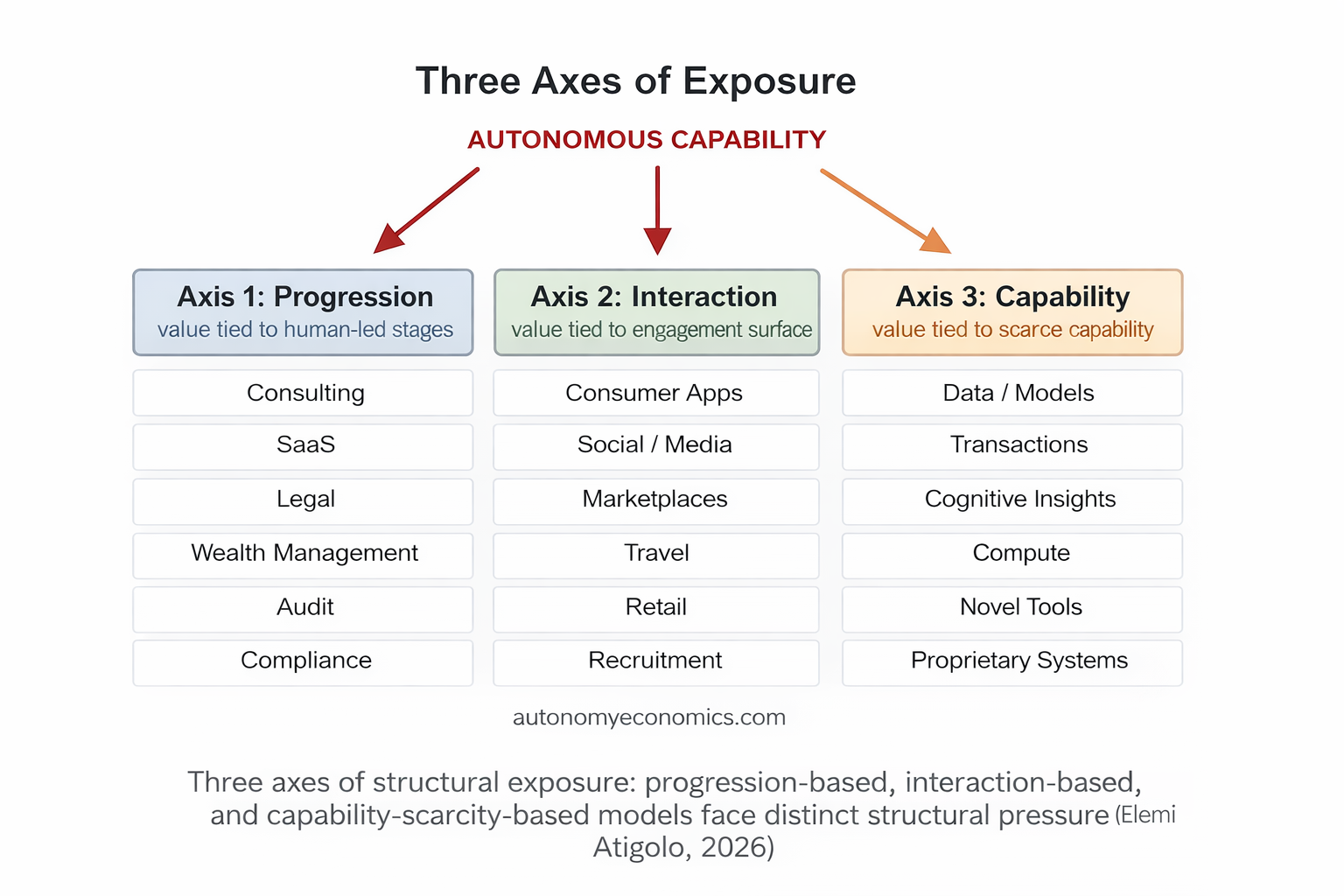
Autonomy Economics identifies three axes of structural exposure through which autonomous capability puts pressure on established commercial models. These axes describe the distinct ways in which value is structured and exposed as autonomous capability advances.
Human-Bounded Progression
Human-bounded progression (HBP) is a core form of exposure in Autonomy Economics. It refers to activity whose movement or completion depends materially on human effort, review, judgement, coordination, or intervention in ways that shape how value is created, justified, or retained. Where a commercial model depends on this structure, autonomous capability makes it possible to carry activity forward with less dependence on continuous human direction.
Exposure is most visible where value capture is anchored directly to human-bounded progression, particularly in consulting, SaaS, legal review, wealth management, audit, and compliance. As that condition weakens, the layer through which value was defined, justified, and defended weakens with it.
Human-Bounded Interaction
Human-bounded interaction (HBI) refers to interaction whose commercial value depends materially on direct human attention, engagement, discovery, navigation, or interface use in ways that shape how demand is formed, routed, or captured. Where a commercial model depends on this structure, autonomous capability can reduce or displace the need for direct human interaction by acting on the user's behalf.
Exposure is most visible in consumer, media, platform, marketplace, and interface-based settings. As agents take over discovery and execution on behalf of users, the traditional engagement-based revenue models face significant structural pressure.
Capability Scarcity Dependence
Capability scarcity dependence (CSD) is the third axis of exposure in Autonomy Economics. It refers to conditions in which value capture depends materially on the limited availability, control, or constrained access to underlying capability in ways that shape how value is created, justified, or retained. Where a commercial model depends on this structure, autonomous capability can expand access, replicate capability, or weaken the scarcity on which that model depends.
Exposure is most visible in models where value depends on control over technical, cognitive, or operational capability, including systems in which access to that capability is priced, bundled, or embedded within a product or service. As autonomous capability improves and diffuses, the scarcity on which those models depend may erode even while underlying capability continues to advance.
The three axes can overlap. Multiple forms of exposure can exist within the same business, with different revenue lines affected through different mechanisms and on different timelines.
See also
- Autonomy Economics (main page)
- What is Autonomy Economics?
- The Agentic Profit Paradox
- The Three Laws
- Value Reorganisation
- The Orchestration Layer
- Outcome-Based Pricing
- Autonomy vs Capability Capture
- Dispersion and Early Pressure
- Frameworks
- Autonomy-Driven Business Models
- Sectoral Exposure
- The Contrary View
- Falsifiability
- Foundation Paper
- Elemi Atigolo
- History
- Frequently asked questions
- Autonomy Economics Evidence Monitor
References
- ^Atigolo, Elemi (February 2026). "The Agentic Profit Paradox". FT The Banker. Financial Times Group. thebanker.com
- ^"Agentic AI Profit Paradox in Banking". Finance AI Insiders. 2026. financeaiinsiders.com
- ^The Agentic Profit Paradox, flagship reference and research site. Autonomy Economics. theagenticprofitparadox.com
- ^Elemi Atigolo, author and founder of Autonomy Economics. Personal site. elemiatigolo.com
- ^"The Agentic AI Profit Paradox: Implications for Swiss Private Banking Clients". SKN CBBA. 2026. skncbba.com
- ^Financial Conduct Authority. "Artificial Intelligence in retail financial services: Engagement Paper." January 2026. fca.org.uk
- ^European Union. "Regulation (EU) 2024/1689 on artificial intelligence." Official Journal. August 2024. eur-lex.europa.eu
- ^Office of the Superintendent of Financial Institutions Canada. "Guideline E-23: Enterprise Risk Management (Model Risk Management and Artificial Intelligence)." Effective May 2027. osfi-bsif.gc.ca
- ^Australian Securities and Investments Commission. "Report 798: Digital Financial Services and Cyber Resilience Vulnerabilities." October 2024. asic.gov.au
- ^American Bar Association. "Formal Opinion 512: The Paradigm for Generative AI in Legal Practice." 29 July 2024. americanbar.org
- ^Health Canada. "Pre-market Guidance for Machine-Learning-Enabled Medical Devices." February 2025. canada.ca
- ^Food and Drug Administration. "Artificial Intelligence-Enabled Device Software Functions: Lifecycle Management." January 2025. fda.gov
- ^World Health Organization. "Ethics and Governance of Artificial Intelligence for Health: Guidance on Large Multi-Modal Models." 18 January 2024. who.int
- ^Bohnsack, R. & de Wet, M. (2025). "AI is the Strategy: From Agentic AI to Autonomous Business Models onto Strategy in the Age of AI." arXiv:2506.17339. arxiv.org
- ^Marks, Howard (February 2026). "AI Hurtles Ahead." Oaktree Capital. oaktreecapital.com
- ^Marks, Howard (December 2025). "Is It a Bubble?" Oaktree Capital. oaktreecapital.com
- ^Reuters (March 2026). "HSBC appoints first chief AI officer as it seeks cost cuts." reuters.com
- ^Reuters (March 2026). "HSBC weighs deep job cuts as AI overhaul unfolds." reuters.com
- ^Financial Times (February 2026). "Consultancies set for fastest growth in years on back of AI boom." ft.com
- ^Jorzik, P., Klein, S. P., Kanbach, D. K. & Kraus, S. (2024). "AI-driven business model innovation: A systematic review and research agenda." Journal of Business Research, 182, 114764. doi.org
- ^Parker, G. G., Van Alstyne, M. W. & Choudary, S. P. (2016). "Platform Revolution: How Networked Markets Are Transforming the Economy and How to Make Them Work for You." W. W. Norton & Company.
- ^Evans, D. S. & Gawer, A. (2016). "The Rise of the Platform Enterprise: A Global Survey." The Center for Global Enterprise.
- ^Foley, S. (6 February 2026). "KPMG pressed its auditor to pass on AI cost savings." Financial Times. ft.com
- ^Davalos, J. and Ford, B. (30 June 2025). "PwC's AI chief says firm has cut prices as tech saves staff time." Bloomberg. bloomberg.com
- ^Salesforce (15 April 2026). "Introducing Salesforce Headless 360. No Browser Required." salesforce.com