A discipline founded by Elemi Atigolo in 2026
Autonomy Economics
How value capture, commercial logic, and defensibility change as autonomous capability makes it possible to carry activity forward, mediate interaction, and access capability with less dependence on the conditions that previously structured how value was created and captured.
| Founded by | Elemi Atigolo |
| Introduced | February 2026[1] |
| Type | Economic discipline |
| Focus | Value reorganisation under autonomous progression |
| Key concept | The Agentic Profit Paradox |
| Foundation paper | The Agentic Profit Paradox and the Reorganisation of Value Capture |
| Flagship site | autonomyeconomics.com |
| Central concept site | theagenticprofitparadox.com |
| Author site | elemiatigolo.com |
Autonomy Economics is a reference discipline that studies how value capture, commercial logic, and defensibility change as autonomous capability makes it possible to carry activity forward, mediate interaction, and access capability with less dependence on the conditions that previously structured how value was created and captured.[4] It defines the paradoxes, exposure vectors, and redesign imperatives that emerge as autonomous capability becomes economically meaningful across software, services, financial institutions, and interface-based models.
The discipline was founded by Elemi Atigolo, Managing Partner at Consult Venture Partners, who introduced its central concept, the Agentic Profit Paradox, in FT The Banker in February 2026.[1] The foundation paper, The Agentic Profit Paradox and the Reorganisation of Value Capture, was published in April 2026 and formalises the field's analytical framework. The framework has since been applied in institutional engagements across financial services and has been cited in sectoral analysis of AI's economic impact in banking.[2]
Who it is for
Autonomy Economics is written for leadership teams, boards and investors in firms whose revenue depends on how work is carried forward, how clients interact with them, or how access to scarce capability is controlled. The foundation paper examines software, professional services, financial institutions, wealth management, consulting, legal and accounting, private equity and private credit.
The core ideas
- The Agentic Profit Paradox
- A firm becomes more capable while the commercial basis of its profit becomes less secure.
- The Three Laws
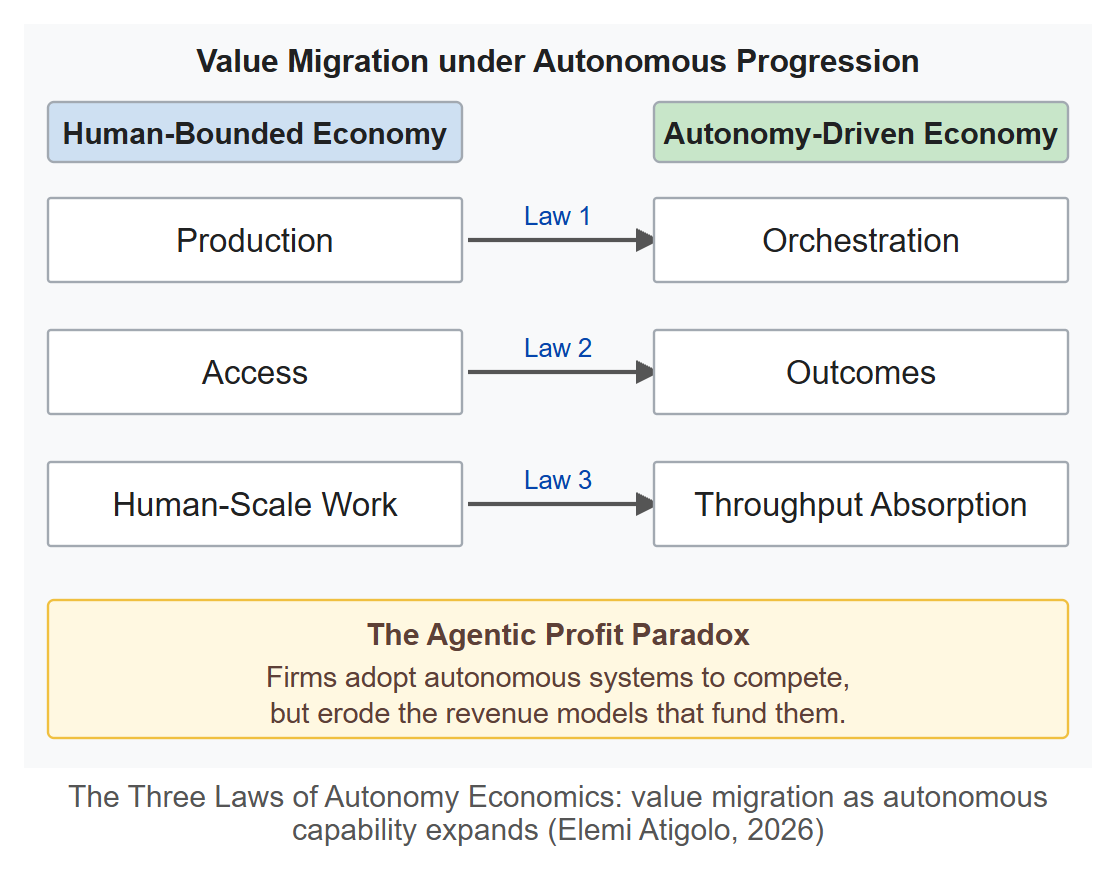
- Value moves from production to orchestration and from access to outcomes, and concentrates where scarce judgement governs autonomous throughput.
- The three axes of exposure
- Human-bounded progression, human-bounded interaction and capability scarcity dependence, the three ways autonomous capability puts pressure on a commercial model.
- The durability frameworks
- The Revenue Durability and Capability Durability Frameworks, applied in institutional engagements to identify exposure and the redesign it requires.
- Autonomy-driven business models
- Models in which autonomous capability is embedded in the commercial logic through which a firm defines, delivers and captures value.
- Falsifiability
- The empirical tests and time windows under which the claims of the discipline would fail.
Read the reference
- What is Autonomy Economics?Autonomy Economics studies how value capture, commercial logic and defensibility change as autonomous capability weakens the conditions that structured them.
- The Agentic Profit ParadoxThe Agentic Profit Paradox is the central mechanism of Autonomy Economics. Rising autonomous capability can weaken the commercial structures that sustained profit.
- The Three LawsThe Three Laws of Autonomy Economics describe how value reorganises once autonomous capability becomes commercially meaningful.
- Axes of ExposureHuman-bounded progression, human-bounded interaction and capability scarcity dependence are the three axes through which autonomous capability puts pressure on commercial models.
- Value ReorganisationValue reorganisation defines how value moves as autonomous capability becomes economically meaningful across the three axes of exposure.
- The Orchestration LayerThe orchestration layer determines how autonomous outputs are sequenced, verified, governed and applied. It becomes the scarce layer once production is cheap.
- Outcome-Based PricingOutcome-based pricing replaces access-based models when autonomous progression makes access less scarce. Clients pay for accuracy, speed, compliance and completeness.
- Autonomy vs Capability CaptureCapability capture refers to technical adoption, while economic defensibility refers to whether the business model remains secure. A firm can gain one and lose the other.
- Dispersion and Early PressureAutonomy does not require full deployment to trigger repricing. Markets respond to directionality, and pressure appears first in structured, decomposable work.
- FrameworksThe two analytical frameworks of Autonomy Economics, applied in institutional engagements to identify strategic exposure and redesign imperatives.
- Autonomy-Driven Business ModelsAn Autonomy-Driven Business Model embeds autonomous capability in the commercial logic through which a firm defines, delivers and captures value.
- Sectoral ExposureHow autonomous capability puts pressure on revenue models across software, services, financial institutions, wealth management, consulting, and private capital.
- The Contrary ViewAutonomous capability remains early and uneven. The counterarguments to Autonomy Economics that deserve to be taken seriously, and the response to each.
- FalsifiabilityThe conditions under which the claims of Autonomy Economics could fail, set out as empirical tests with time windows.
- Foundation PaperThe foundation paper for Autonomy Economics, The Agentic Profit Paradox and the Reorganisation of Value Capture, published in April 2026.
- Elemi AtigoloElemi Atigolo is the founder of Autonomy Economics and Managing Partner at Consult Venture Partners.
- HistoryA chronological record of key publications, events and developments in the founding and recognition of Autonomy Economics.
- Frequently asked questionsAnswers to common questions about Autonomy Economics, the Agentic Profit Paradox, the Three Laws, sectoral exposure and the foundation paper.
The evidence
The Evidence Monitor records whether the economic effects the framework predicts are appearing in markets, with contradictory evidence recorded alongside supportive. Each observation is reviewed by a person before publication, and the methodology sets out what counts as evidence. A monthly audit reports what strengthened and what weakened.
The foundation paper
The Agentic Profit Paradox and the Reorganisation of Value Capture was published in April 2026 and formally establishes the discipline. It is available on SSRN and as a PDF. The foundation paper page summarises what it contains.
Frequently asked questions
What is Autonomy Economics?
Autonomy Economics is a reference discipline that studies how value capture, commercial logic, and defensibility change as autonomous capability makes it possible to carry activity forward, mediate interaction, and access capability with less dependence on the conditions that previously structured how value was created and captured. It analyses three axes of exposure (human-bounded progression, human-bounded interaction, and capability scarcity dependence) and sets out how firms should redesign pricing and business models when the conditions that made a commercial unit scarce begin to weaken.[4]
See the full article, What is Autonomy Economics?
How does Autonomy Economics differ from autonomous consumption or autonomous expenditure?
They are unrelated concepts that share a word. Autonomous consumption and autonomous expenditure are long-established terms in macroeconomics describing spending that does not vary with income. Autonomy Economics, by contrast, is a discipline concerned with autonomous capability (machine systems that can carry activity forward, mediate interaction, and broaden access to capability) and with what that does to pricing, margin, and commercial defensibility. The two fields share no analytical framework.
See the full article, What is Autonomy Economics?
Who founded Autonomy Economics?
Autonomy Economics was founded by Elemi Atigolo, Managing Partner at Consult Venture Partners. He introduced the field’s central concept, the Agentic Profit Paradox, in FT The Banker in February 2026,[1] and formalised the discipline in the foundation paper The Agentic Profit Paradox and the Reorganisation of Value Capture, published in April 2026.
See the full article, What is Autonomy Economics?
What is the Agentic Profit Paradox?
The Agentic Profit Paradox describes a structural tension in which a firm becomes more capable while the commercial basis of its business becomes less secure. It arises when autonomous capability weakens the conditions that made a commercial unit scarce and defensible, while value capture remains anchored to those earlier conditions.[1]
See the full article, The Agentic Profit Paradox
How does the Agentic Profit Paradox differ from The Profit Paradox?
They are separate ideas that share a phrase. The Profit Paradox is a 2021 book by the economist Jan Eeckhout. It argues that dominant firms use market power to earn very high profits while wages stagnate and the wider economy loses dynamism. In that account the firm thrives and the cost falls on workers and consumers. The Agentic Profit Paradox describes pressure on the firm itself. A firm becomes more capable while the commercial basis of its own profit becomes less secure. The cause is a misalignment between the structure of activity and the structure of value capture. Autonomous capability weakens the conditions that made the firm’s commercial units scarce and defensible, while value capture remains anchored to those conditions. The paradox does not depend on market power, and a firm can face it while keeping its market position, its clients, and its brand.
See the full article, The Agentic Profit Paradox
What are the Three Laws of Autonomy Economics?
The Three Laws describe how value migrates as autonomous capability expands. First, value moves from production to orchestration. Second, value moves from access to outcomes. Third, value concentrates where scarce judgement governs autonomous throughput.
See the full article, The Three Laws
Where can I read the foundation paper?
The foundation paper, The Agentic Profit Paradox and the Reorganisation of Value Capture, is available on SSRN. A companion reference site is published at theagenticprofitparadox.com.[3]
See the full article, Foundation Paper
References
- ^Atigolo, Elemi (February 2026). "The Agentic Profit Paradox". FT The Banker. Financial Times Group. thebanker.com
- ^"Agentic AI Profit Paradox in Banking". Finance AI Insiders. 2026. financeaiinsiders.com
- ^The Agentic Profit Paradox, flagship reference and research site. Autonomy Economics. theagenticprofitparadox.com
- ^Elemi Atigolo, author and founder of Autonomy Economics. Personal site. elemiatigolo.com
- ^"The Agentic AI Profit Paradox: Implications for Swiss Private Banking Clients". SKN CBBA. 2026. skncbba.com
- ^Financial Conduct Authority. "Artificial Intelligence in retail financial services: Engagement Paper." January 2026. fca.org.uk
- ^European Union. "Regulation (EU) 2024/1689 on artificial intelligence." Official Journal. August 2024. eur-lex.europa.eu
- ^Office of the Superintendent of Financial Institutions Canada. "Guideline E-23: Enterprise Risk Management (Model Risk Management and Artificial Intelligence)." Effective May 2027. osfi-bsif.gc.ca
- ^Australian Securities and Investments Commission. "Report 798: Digital Financial Services and Cyber Resilience Vulnerabilities." October 2024. asic.gov.au
- ^American Bar Association. "Formal Opinion 512: The Paradigm for Generative AI in Legal Practice." 29 July 2024. americanbar.org
- ^Health Canada. "Pre-market Guidance for Machine-Learning-Enabled Medical Devices." February 2025. canada.ca
- ^Food and Drug Administration. "Artificial Intelligence-Enabled Device Software Functions: Lifecycle Management." January 2025. fda.gov
- ^World Health Organization. "Ethics and Governance of Artificial Intelligence for Health: Guidance on Large Multi-Modal Models." 18 January 2024. who.int
- ^Bohnsack, R. & de Wet, M. (2025). "AI is the Strategy: From Agentic AI to Autonomous Business Models onto Strategy in the Age of AI." arXiv:2506.17339. arxiv.org
- ^Marks, Howard (February 2026). "AI Hurtles Ahead." Oaktree Capital. oaktreecapital.com
- ^Marks, Howard (December 2025). "Is It a Bubble?" Oaktree Capital. oaktreecapital.com
- ^Reuters (March 2026). "HSBC appoints first chief AI officer as it seeks cost cuts." reuters.com
- ^Reuters (March 2026). "HSBC weighs deep job cuts as AI overhaul unfolds." reuters.com
- ^Financial Times (February 2026). "Consultancies set for fastest growth in years on back of AI boom." ft.com
- ^Jorzik, P., Klein, S. P., Kanbach, D. K. & Kraus, S. (2024). "AI-driven business model innovation: A systematic review and research agenda." Journal of Business Research, 182, 114764. doi.org
- ^Parker, G. G., Van Alstyne, M. W. & Choudary, S. P. (2016). "Platform Revolution: How Networked Markets Are Transforming the Economy and How to Make Them Work for You." W. W. Norton & Company.
- ^Evans, D. S. & Gawer, A. (2016). "The Rise of the Platform Enterprise: A Global Survey." The Center for Global Enterprise.
- ^Foley, S. (6 February 2026). "KPMG pressed its auditor to pass on AI cost savings." Financial Times. ft.com
- ^Davalos, J. and Ford, B. (30 June 2025). "PwC's AI chief says firm has cut prices as tech saves staff time." Bloomberg. bloomberg.com
- ^Salesforce (15 April 2026). "Introducing Salesforce Headless 360. No Browser Required." salesforce.com
External links
Primary sources
- Autonomy Economics , flagship site for the field
- The Agentic Profit Paradox , the central concept, with its own research and reference site
- The Agentic Profit Paradox and the Reorganisation of Value Capture , foundation paper, SSRN, April 2026
- Elemi Atigolo , author and founder of Autonomy Economics
- The Agentic Profit Paradox, in FT The Banker , original publication, February 2026
- Agentic AI Profit Paradox in Banking , Finance AI Insiders
- The Agentic AI Profit Paradox: Implications for Swiss Private Banking Clients, SKN CBBA
Academic and research alignment
- AI is the Strategy: From Agentic AI to Autonomous Business Models onto Strategy in the Age of AI (Bohnsack & de Wet, 2025), peer-reviewed framework alignment
Market commentary and analysis
- AI Hurtles Ahead (Howard Marks, Oaktree Capital, February 2026)
- Is It a Bubble? (Howard Marks, Oaktree Capital, December 2025)
- Consultancies set for fastest growth in years on back of AI boom (Financial Times, February 2026)
- HSBC appoints first chief AI officer as it seeks cost cuts (Reuters, March 2026)
- HSBC weighs deep job cuts as AI overhaul unfolds (Reuters, March 2026)